Methodology for FIC Directory Statistics Project
For the data nerds

The Dataset - How I Got It and How I Cleaned It
The Foundation for Intentional Community (FIC) publishes a physical version of their directory and has done so for years. I used the 2016 directory. While the directory information looks like a spreadsheet, the formatting is different so I had to copy and paste the information into an actual spreadsheet. Even though this seems like a problem a computer-savvy person could easily fix, it is not, and the best way to handle it is to do the long, tedious process of copying the information manually.1 When copying information, I decided to only include established communities2 and did not include forming communities (ones that are in the process of being created).
The data I used from the directory is not from a research survey. It is not a random sample of communities and the questions are geared primarily to what people seeking intentional community would be interested to know. Communities are in the directory if they seek to be listed. Below is an excerpt from the directory handbook indicating that the FIC encouraged communities to update their information for the 2016 handbook, though that likely means some communities did not do so and the information was out-of-date.
The data for the cross-reference charts was collected through the Online Communities Directory at directory.ic.org in June of 2016. Great effort was made to have all communities update their information by a call to respond to a new questionnaire designed to provide as much useful information for community seekers as could be available in this format.
After entering in all the information into a spreadsheet, I cleaned the data in two main ways. First, I checked online for the state or country of a community if that information was missing. Broad location information is easy to find for most intentional communities and only seems to be missing for some in the directory’s chart (yet is not missing in the online directory). Other than location, I did not attempt to find any other missing information. Second, I removed a few communities for the following reasons:
Not an intentional community (some organizations were in the directory that were related to intentional communities but are not a place where people live).
Forming communities that were not listed as forming including those whose year of founding was in the future.
There were fewer than 4 combined members and non-members.
This was not a perfect process. I did not check each community. I found these examples that were non-qualifying by checking communities where most of the answers were missing or through their websites when looking for missing location information.
Like all data but especially data that was not collected as part of a research survey, it’s messy. Broadly speaking, I took a hands off approach to inconsistencies. For example, some large intentional communities that are made up of multiple smaller communities vary in whether they classified themselves as one community or as multiple in the directory. Twelve Tribes for examples listed each of their locations separately (i.e. Twelve Tribes in Boulder was a separate listing from Twelve Tribes in Ithaca) while others such as the Bruderhof Communities keep all of their information in one listing. The other cleaning I did was converting all property sizes into acres.
While analyzing all this information, I am trying to be clear about the limitations of the data. Below are more excerpts from the directory handbook about how many of these questions represent information that can change quickly overtime or is oversimplified.
Some information (such as total population) may become outdated quickly, while other data (such as year founded) are stable. Other information (such as diet) can be misleading in its simplicity when the reality is usually very complex.
As mentioned before, the FIC is not in a position to verify the data provided by each community. We suggest using the data as a guide while keeping in mind that this is just a snapshot of how that community (or more precisely the person filling out the questionnaire) presented itself at the time.
Even though the directory is imperfect, especially for statistical analysis, there is value in looking at broad trends in what these analyses can show. As the popular saying goes “all models are wrong, but some are useful.”
Notes on Representativeness
The directory data is not a random sample. We do not know how representative the directory is of intentional communities as a whole and that also depends greatly on how we define intentional community. The definition used by FIC3 is broad and includes many groups who are not in the directory. Since the information comes from a public directory the data skews toward communities that are actively recruiting online, have some type of business they are advertising for, and where the members see themselves as part of a broader intentional community movement.
While working on this project, I realized that I live in a community that could qualify to be in the directory. We are four unrelated adults who live together in a house we co-own. We have an agreed upon decision making structure and most of the questions are relevant to our setup. Even so it never occurred to us to be in the directory. Our group is small. Our setup is more informal and less ambitious than most intentional communities. Most important is that we aren’t seeking new members nor do we accept visitors because we’re just four adults living our fairly normal lives in a big house. There are probably many communities like us including larger groups whose members value privacy and do not wish to be in a global directory. We can see this in the charts below on the answers to whether the communities are open to new members or to visitors.
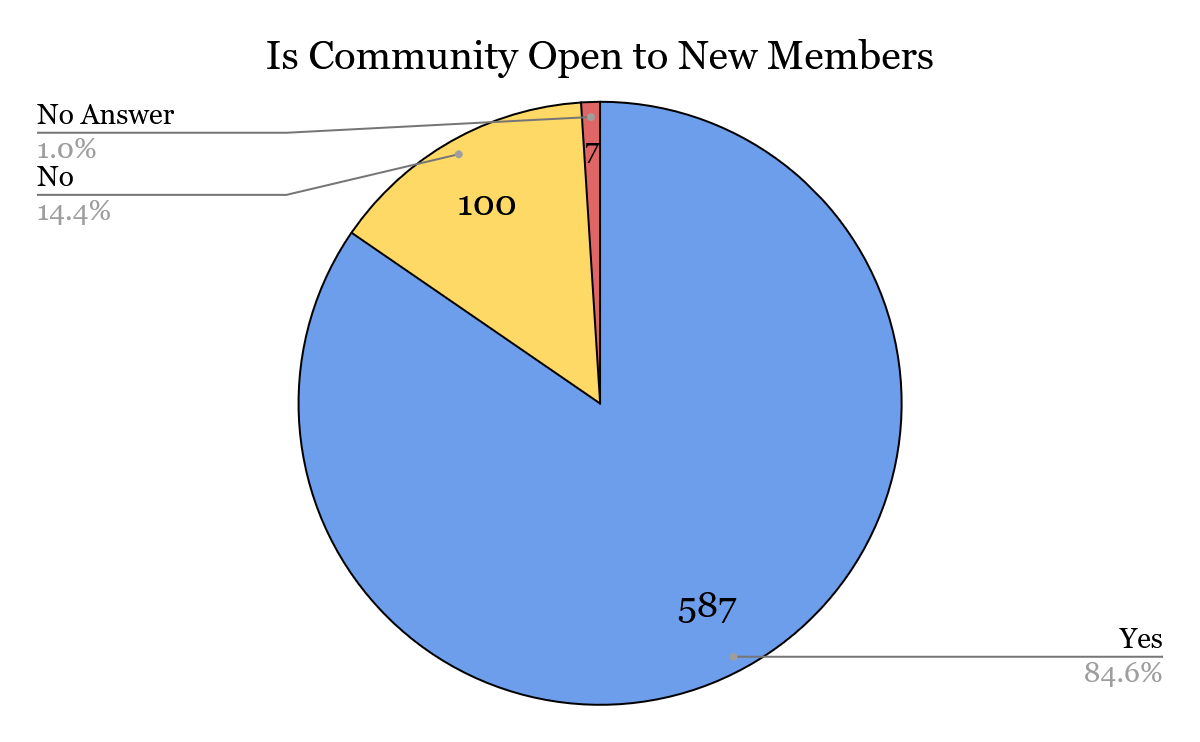
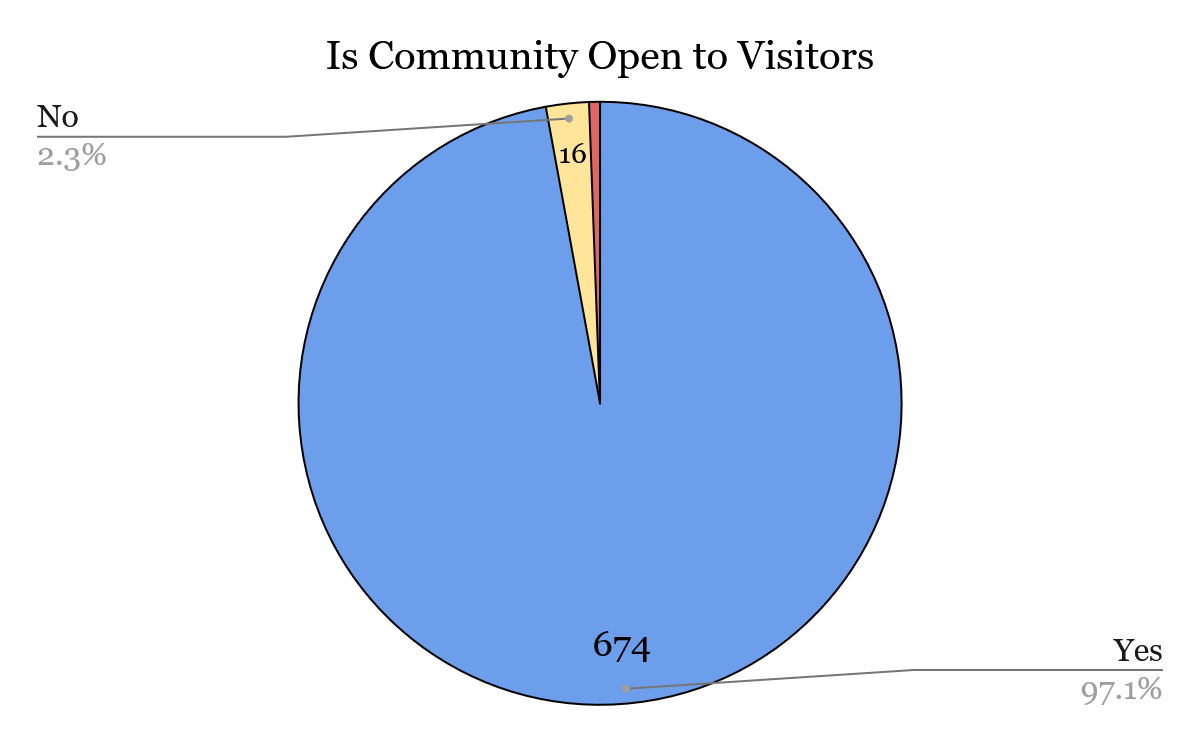
84.6% of communities in the directory were open to new members and 97.1% are open to visitors. Going further, many communities in the directory have some type of public facing business. They operate campgrounds, workshops, classes, or paid tours to the public. FIC has paid advertising by communities who want people to know about their businesses or who need new members. I am not criticizing these communities for having businesses. It’s just an obvious way that the directory does not represent all intentional communities and other forms of communal living. Communities without public facing businesses who do not recruit online have much less of a need to be in a public directory.
So the directory is not representative of all communities, but it is one of the largest samples of intentional communities that exists. There are many types of communities in the dataset. One of the most interesting findings from looking at trends has been seeing how much variety there is in these communities.
Feel free to comment or send a direct message if you have any questions about the data or requests for questions that I can potentially answer with the dataset.
I’ve encountered this problem before when using published data-like information that is not formatted as a spreadsheet. I then talked to multiple engineers about whether there was an easy way to code this into a spreadsheet and all of them told me there isn’t, not unless each “cell” is of the same length. If someone knows a better solution, I’d love to hear it, unless it is generative AI as I do not trust it would be accurate.
For the purposes of this post, “communities” refers to “intentional communities” unless otherwise specified.